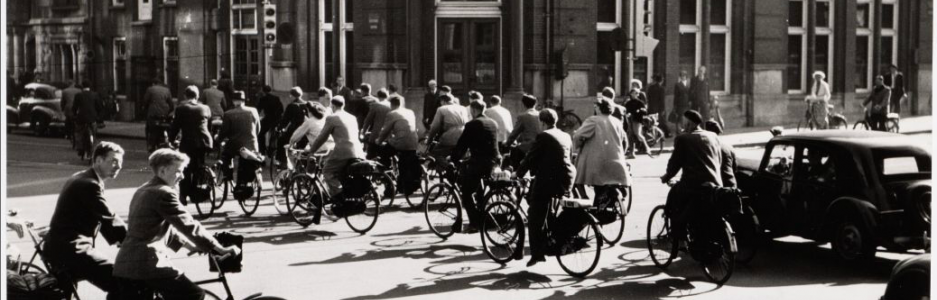
Monitoring, modeling, managing and designing active mode infrastructure to keep travelers safe and help these systems perform at their best.
Cities around the world are looking for ways to grow sustainably, towards a future in which traffic pollution, noise and congested city centers belong to the past. Walking and cycling are central to that ambition. When more people choose active modes, cities become cleaner, healthier and more liveable. To unlock their full potential, however, active mode infrastructure has to be designed and operated around the needs of the people who use it.
My research focuses on designing and managing active mode infrastructure. I am fascinated by the order hidden in the seemingly chaotic movements of pedestrians and cyclists. I aim to uncover insights that help us create infrastructure that performs optimally, where travelers feel safe, confident in finding their own way, and able to enjoy their journey.
My work covers the full chain from understanding behavior to managing networks:
- Understanding behavior: empirical studies of route, exit, and mode choice through field experiments, laboratory studies, and virtual reality.
- Modeling and simulation: developing and calibrating microscopic and macroscopic models of pedestrian and bicycle flows.
- Monitoring and data analysis: crowd monitoring systems that combine sensor data (Wi-Fi, counting systems, Radar, GPS) and new AI methods for predicting active-mode traffic.
- Managing networks: using intelligent transportation systems (ITS) and smart management measures to keep busy places such as event sites, stations and city centers safe and accessible.
In all of this, I work closely with municipalities, event organizers, security organizations, transport hubs and engineering firms so scientific insights make their way into practice.

